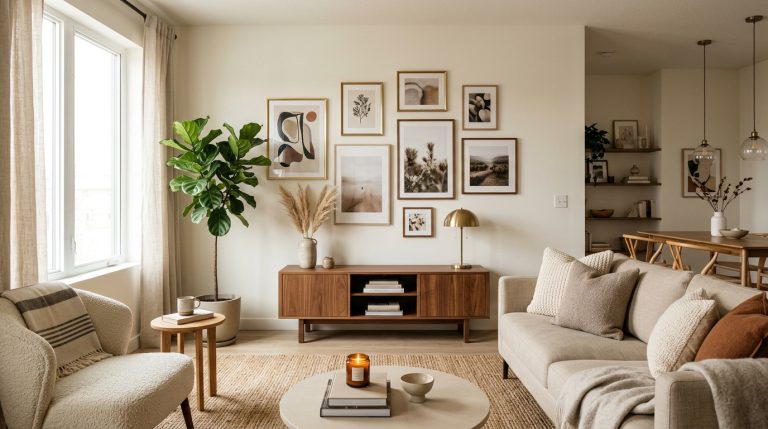
Living Room Furniture Layout Rules and When to Break Them
My living room had that “rental beige” look no matter what I tried — until I figured out it was the curtains. But even after getting those sorted, the room still felt… off. Like a waiting room, not a living room. I spent way too long rearranging my hand-me-down sofa and mismatched chairs, only to end up with the same awkward feeling. It wasn’t the furniture itself, I realized; it was where it was placed. I was following the “float your furniture” rule without understanding why or when to break it, and it was making my small space feel even smaller.
Affiliate Disclosure: As an Amazon Associate, we earn from qualifying purchases. This means we may earn a small commission when you click our links and make a purchase on Amazon. This comes at no extra cost to you and helps support our site.
The “Float Your Furniture” Rule: Good in Theory, Tricky in Practice
You hear it everywhere: “Don’t push all your furniture against the walls!” And for good reason — in large rooms, pulling furniture away from the perimeter can create cozy conversation areas and make the space feel more inviting and less like a sterile dance hall. I live in a 10×12 foot living room. When I tried to float my full-size sofa and two armchairs, it felt like I was navigating an obstacle course. There was barely enough room for my coffee table, let alone actual walking paths. Everything felt crammed into the center, and the perimeter just collected dust. It was a mess.
What I learned: The “float your furniture” rule primarily applies to rooms that are large enough to comfortably accommodate walkways behind the furniture. If your room is under, say, 15×15 feet, you need to be very strategic about floating. My 10×12 room simply couldn’t handle a full float. I ended up pushing my 86-inch sofa almost entirely against the longest wall, leaving just enough space (about 6 inches) behind it for the baseboard and to allow the curtains to hang freely without getting squished. This maximized the perceived width of the room.
Rug Size: The Rule You Absolutely Cannot Break (Mostly)
This is where I truly wasted money. I bought a 5×7 rug for my 10×12 living room, thinking it was “big enough.” It was not. It looked like a postage stamp floating in the middle of the room, barely touching the front legs of my sofa. It made the entire seating area feel disconnected and undersized. My advice: measure your room and then measure again. For a 10×12 room, you need at least an 8×10 rug. Ideally, you want all the front legs of your main seating pieces (sofa, armchairs) to be on the rug. If you can only afford an 8×10 for a 10×12 room, position it so the front legs of the sofa and any accent chairs are on it. The back legs might be off, and that’s usually okay. I ended up returning that 5×7 (thank goodness for free returns at Target!) and splurged on an 8×10 from Overstock. I got a Safavieh Florida Shag rug for about $180 on sale — it’s held up well for two years with a dog and two kids, which is saying something. Skip the cute patterned rugs from Wayfair under $100 — I’ve had two and they always look cheap after a few months and the edges fray.
The Coffee Table Conundrum: Too Big, Too Small, or Just Right?
Another common mistake I made was buying a coffee table that was either too big or too small. My first coffee table was a huge, square, hand-me-down that took up too much of the precious space between my sofa and TV console. It made it impossible to walk around comfortably. The rule of thumb is that your coffee table should be about two-thirds the length of your sofa and placed 14-18 inches from the sofa. This allows for comfortable reach and walkability. My 86-inch sofa needed a coffee table in the 57-inch range. I found a rectangular, simple wooden one from Amazon for about $80 that was 50 inches long, and it was perfect. It wasn’t exactly two-thirds, but it was close enough to look balanced without being a literal tripping hazard. Sometimes, getting within a few inches is good enough, especially when you’re on a budget.
TV Placement: The Rule You Might Actually Break
The “ideal” TV viewing distance rule suggests placing your TV a certain number of feet away based on its size (e.g., 8-12 feet for a 65-inch TV). In a small living room, this is often impossible. My TV is 55 inches, and my sofa is only 7 feet away. Is it “ideal”? Probably not according to the experts. But is it comfortable and functional? Absolutely. I couldn’t move my sofa back any further without blocking the only window. So, I broke the rule. The key here is not to strain your neck. Make sure the center of the TV is roughly at eye level when you’re seated. I mounted my TV on the wall with a $25 mount from Amazon, which freed up space on my media console and allowed me to put it higher than it would have been on a stand. This made a huge difference in comfort and visual balance.
Accent Chairs: The Balancing Act
I have two accent chairs. One is a vintage mid-century modern style, and the other is a simple fabric armchair I got from Big Lots for $150 (a steal!). The rule is to create a conversation area. In my small room, this meant placing them opposite the sofa, or at least angled towards it. But again, space was an issue. What I found worked best was placing one armchair directly opposite the sofa, slightly angled inward, and the other in a corner, also angled towards the sofa. This created a U-shape without completely blocking the room. Instead of matching them, I used different styles but similar color tones, which kept it from looking too “matchy-matchy” and helped break up the visual weight in a small room. A lighter fabric armchair in one corner and a darker, more visually heavy wood frame chair in another. This prevented the room from feeling too symmetrical and stiff.
What to do this weekend: Grab a tape measure, some painter’s tape, and a notebook. Measure your living room walls, then your existing furniture (sofa, chairs, coffee table). Use the painter’s tape on your floor to outline where you *think* your furniture should go based on the rules (rug first!). Then, outline where the front legs of your sofa and chairs would sit on the rug. See if it makes sense for your space. Don’t be afraid to push that sofa closer to the wall if your room is small.