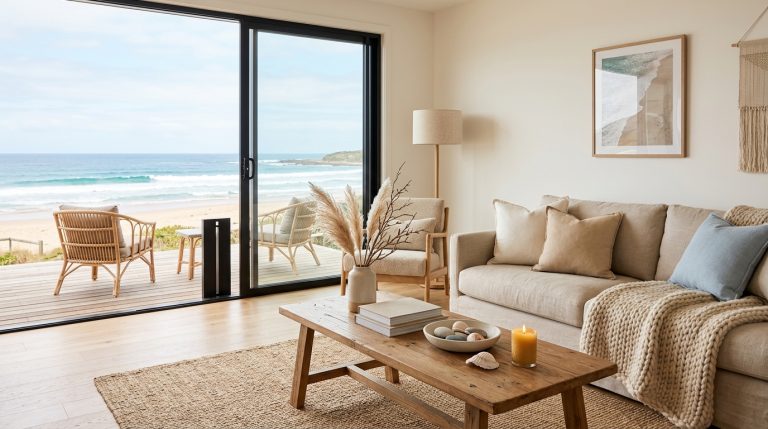
How to Pick the Right Paint Color When Every Swatch Looks the Same
My living room had that “rental beige” look no matter what I tried – until I figured out it was the curtains. But even after I tackled the window treatments, the walls themselves were still… just okay. I spent months staring at paint swatches, convinced I was colorblind because every single off-white looked exactly the same on the tiny card, then wildly different once I slapped it on the wall. I ended up with a living room that was supposed to be a warm greige but came out looking like a sickly lavender in certain lights. It was not the cozy vibe I was going for, and I learned some hard lessons about picking paint colors without losing my mind (or my deposit on custom color mixing).
Affiliate Disclosure: As an Amazon Associate, we earn from qualifying purchases. This means we may earn a small commission when you click our links and make a purchase on Amazon. This comes at no extra cost to you and helps support our site.
Stop Staring at the Swatch Card
First mistake: trusting the tiny paint swatch. I get it, they’re free and easy. But they are a lying, manipulative little piece of paper. The lighting in the store is never the same as your home. The size is so small that your brain can’t properly register the undertones. I’d bring home a handful of promising swatches from Benjamin Moore — mostly from their “Off-Whites Collection” — like "Ballet White," "Swiss Coffee," and "White Dove." They looked fantastic next to each other in the store. On my wall, "Ballet White" suddenly had a pinkish hue I never saw. "Swiss Coffee" pulled much yellower than I wanted. Don’t even get me started on the "greiges" that turned purple. You absolutely, positively need to see the color in your actual space.
What actually works? Buy samples. Yes, it’s an upfront cost, but it will save you hundreds of dollars and hours of repainting later. Most paint brands sell small sample pots – about 8 oz – for $5-7. My local Sherwin-Williams sells their "Color to Go" samples for $7.99. Buy at least three colors you like. I usually pick one that’s a bit warmer, one that’s a bit cooler, and one that’s a true neutral if I’m going for a white or light gray. For example, if I’m looking for a warm white, I’d get samples of Benjamin Moore’s "White Dove" (a classic warm white), "Acadia White" (a bit creamier), and maybe "Classic Gray" (which despite the name, reads as a very soft, barely-there greige in many spaces). Don’t try to get by with just one; you need comparison.
Paint Large Patches, Not Tiny Stripes
Once you have your samples, don’t just paint a tiny square in a corner. That’s what I did the first time, and it was useless. You need to see the color in a significant enough area to gauge its true appearance. Paint at least two large patches (about 2×2 feet each) on different walls in the room you’re painting. I usually pick the wall that gets the most natural light and the wall that gets the least. This helps you see how the color shifts throughout the day. I learned this the hard way after painting my dining room with what I thought was a lovely light gray, only to discover the wall opposite the window looked like a dungeon at night, while the sunniest wall looked almost white.
Don’t paint directly over your current wall color if it’s a strong shade. The underlying color will affect how the sample looks. Instead, pick up a large white poster board from the dollar store (I get mine at Dollar Tree for $1.25 for a 22"x28" board). Paint your samples on the poster board. This gives you a clean, neutral background and allows you to move the painted board around the room. You can hold it up next to your trim, your furniture, and your existing artwork. This is a game-changer because you can see the color in different lights and against different elements without having to repaint a wall section multiple times.
Observe the Color at Different Times of Day
This is where patience comes in. Once you’ve painted your large patches (or your poster boards), leave them up for at least 24 hours. Observe them in the morning light, midday, late afternoon, and under artificial lighting at night. This is crucial. Many colors have surprising undertones that only reveal themselves under specific lighting conditions. That "greige" that looked perfectly neutral at noon might pull purple at dusk. That crisp white might suddenly look too stark under your warm LED bulbs. My "sickly lavender" living room was a prime example – it looked fine in bright morning sun, but by the time evening rolled around and my lamps were on, it was undeniably lilac.
Consider the direction your room faces. A north-facing room typically gets cooler, softer light, so a warmer paint color can help balance that out. A south-facing room gets bright, warm light all day, so a cooler tone might prevent it from feeling too yellow or orange. East-facing rooms get beautiful morning light, but can feel dim in the afternoon. West-facing rooms get intense afternoon light and warm sunsets. I never thought about this until a paint store associate asked me about my room’s orientation, and it suddenly clicked why some colors worked in one room of my house but not another.
Don’t Overthink the Undertones (But Don’t Ignore Them Either)
You’ll hear a lot of talk about "undertones" — the subtle hints of red, blue, green, or yellow that can make a neutral color lean one way or another. While you don’t need to become an expert color theorist, being aware of them will save you grief. If you’re looking for a true gray, and it has a blue undertone, it will look blue in certain lights. If it has a green undertone, it might look slightly mossy. The easiest way to spot them is by comparing colors. If you hold up two "grays" side-by-side, and one looks distinctly warmer or cooler than the other, you’re seeing their undertones at play. If you want a neutral, try to find a color that doesn’t lean too heavily in any direction when you move it around the room on your poster board.
For my current living room, after the "lavender greige" disaster, I went with Sherwin-Williams "Agreeable Gray." I bought samples of it, "Revere Pewter" (which I found pulled a bit too brown in my light), and "Repose Gray" (which was a touch too cool). "Agreeable Gray" truly lived up to its name — it’s a warm greige that never looks too brown, too purple, or too cold in my south-facing living room. It costs about $60 a gallon, but I waited for their 30-40% off sales, which happen pretty regularly, and got it for around $38 a gallon.
So, your concrete action for this weekend: head to the paint store, pick out three sample pots of colors you think might work – one slightly warm, one slightly cool, and one truly neutral. Grab a white poster board from the dollar store. Paint large squares of each color on the board and tape it to your wall. Then, just live with it for a day or two. Watch how the colors change. You’ll be amazed at what you learn.
Frequently Asked Questions
Why do paint swatches often appear identical, making selection difficult?
Swatches look similar due to lighting variations, small size, and how our eyes perceive color in different environments. Natural and artificial light drastically alter a color’s appearance, making differentiation challenging on a small scale.
What’s the best way to accurately test paint colors before committing?
Paint larger sample areas on different walls, observing them throughout the day and night under various lighting conditions. Don’t rely solely on small paper swatches; consider peel-and-stick samples or actual paint pots for better representation.
What factors should I consider beyond the swatch when choosing a paint color?
Consider your room’s natural light, existing furniture, flooring, and the overall mood you want to create. Test colors next to these elements, as they significantly influence how the paint color will ultimately appear.
Instant digital download — print at home or at your local print shop
Similar Posts
Coastal Decorating Ideas for a Relaxing Home Vibe
Girl, remember how you were saying your living room feels a little… heavy? Like, you love your comfy couch, but everything else just kinda sits there, not really inviting you to kick back? I totally get it. My own living room used to have this dark, almost stuffy vibe, and I knew I wanted that…